Showing posts with label autoimmune. Show all posts

Wednesday, June 29, 2016

Sunset Jicama and Apple Slaw

This crunchy, refreshing, raw salad is perfect for anyone on a balancing or cleansing diet.  Jicama is a Mexican tuber high in vitamin C and healing to the immune system. This fiber-rich dish is packed with prebiotics, which are are metabolized in the intestines, where our bacteria can then use it for energy. I'd take this to the beach with me or on a picnic.
By Katie Ring

Serves 4
Tools: knife, cutting board, peeler, food processor or grater


Ingredients:
1 small Jicama
2 green apples
1 medium carrot
Juice of 1-2 limes
Optional: spearmint


Method:
-First we’ll prep ingredients. Take your peeler and peel tough skin off jicama.  Using a large chef’s knife, cut off bottom of jicama, so it rests flat on your cutting board.  Cut jicama into rectangles.  Set aside.
-Cut apples into quarters, discarding seeds and stem.  Set aside.
-If using food processor, use the shredding blade and one-at-a-time, feed the jicama, apple, and carrot through.  If using a cheese grater, this process will take a bit longer, but it can be done the same way.  

-Transfer shredded mixture to a large bowl and add lime juice.  Let marinade in fridge for 20 minutes.  Top with spearmint if you desire!

Dreamy Chocolate Chia Pudding


This can be made several days in advance, as it will keep refrigerated for 3 days. The longer the seeds sit, the more liquid they can absorb. Chia seeds are fiber beasts! They aid in digestion, and are loaded with Omega-3 fats, which improve brain function. Raw cacao is high in minerals like magnesium as well as antioxidants to protect our cells from damage. This dessert is so supportive that it gives me an excuse to eat chocolate pudding for breakfast!
By Katie Ring
Serves 4

Ingredients:
⅓ cup chia seeds
1 ¾ cup Cinnamon-Vanilla Coconut Milk
2 Tbs raw cacao powder
1 small pinch sea salt
optional: maple syrup to sweeten, banana chips and granola, coconut whipped cream, toasted hazelnuts and cherries

Method:
-Soak chia seeds in coconut milk. Let sit for 10 minutes and stir.  Allow to sit for at least 10 minutes longer or overnight.
-In a medium mixing bowl, whisk hydrated chia seeds with remaining ingredients.  Add sweetener like maple syrup or stevia to your liking. Scoop into small bowls and serve with any of the optional toppings.  Indulge freely!


Sunday, February 15, 2015

Creamed Butternut Squash Pasta with Sage Butter


What a cozy winter meal! I originally made a version of this super satisfying dish for 20 retreat-goers a couple weeks ago in the peaceful Santa Cruz mountains.  With just a few ingredients, this easy dish is nutrient-dense, slightly sweet and makes an awesome creamy substitute for you mac & cheese lovers.

Make this recipe dairy free by using ghee or refined coconut oil instead of butter.  To make this AIP friendly, swap brown rice pasta out for zucchini noodles and use 1/2 tsp turmeric and 1/4 tsp mace instead of coriander.  

Creamed Butternut Squash Pasta with Sage Butter

Yield: 4 servings
Allergens: dairy. 

Ingredients  

3-4 medium garlic cloves
3 Tbs olive oil, divided
2 medium butternut squashes, peeled, seeds removed, and cut into medium chunks
2 cups fresh mushrooms, thinly sliced
1 bag brown-rice pasta; I like the spiral pasta, rotini
1 bunch of fresh sage, finely diced
6 Tbs organic butter (ghee or coconut oil work too)
1-2 cups of bone broth (you can also use chicken or vegetable broth)
1 tsp coriander
1/2 a bag of arugula (you can subsitute spinach)
salt and pepper to taste
optional: meatballs or other protein


Directions:
  1. Preheat oven to 400°F.  In a sheet of parchment, wrap peeled garlic cloves with a touch of oil and roast for 30 minutes.  Toss squash with 1 Tbs oil, salt, pepper and place in large baking dish in oven for 30 minutes, checking halfway. Once cubes are soft all the way through and slightly browned, remove from oven to cool slightly. Remove garlic and set aside.
  2. In medium saucepan, heat 1 Tbs olive oil.  Sauté mushrooms for 5 or so minutes.  Season with salt and pepper.  Set aside.
  3. Using an immersion blender or stand blender, combine squash, roasted garlic, coriander, salt and pepper to taste.  Start by adding 1 cup of broth. If the mixture is not blending, add a quarter cup extra at a time until a thick consistency is reached, but not watery.
  4. In a large pasta pot, boil water with a few pinches of salt and a couple dashes of olive oil. Cook pasta according to directions on packaging.
  5. While pasta is cooking, over low heat, brown the butter and infuse with sage, stirring occasionally.
  6. Once pasta is cooked through, drain it and pour back into pasta pot.  Add sage butter and combine with pasta thoroughly.  Mix in the arugula and mushrooms.  Finally, stir in the creamed squash.  Feel free to add a protein, like meatballs or shredded chicken. Garnish with sage.

Friday, December 26, 2014

If you don't know, now you know…how to make easy zucchini noodles

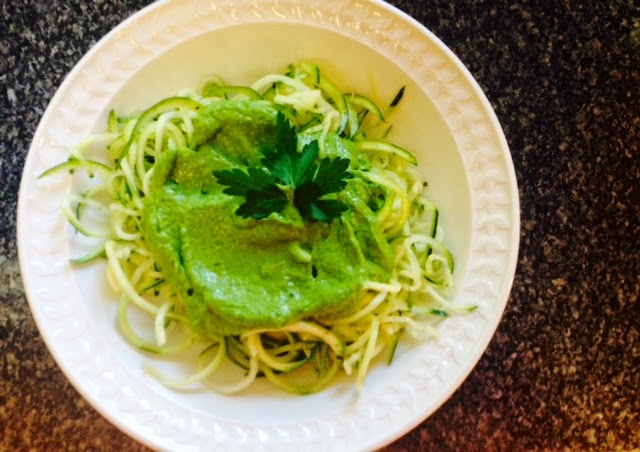
Raw zucchini noodles with herbed avocado pesto
I know it's not right to love or need an object, but when it comes to some things in my kitchen, there are a few items that I would really not like to live without :) Right after my first two children: my chef knife and Vitamix, I have a new baby that I am so so glad my friend Laura turned me onto last year: the Spirooli™or Spiralizer™.  These bad ass slicers can turn vegetables into tasty noodles in seconds.  Let's be honest, slurping your vegetables in noodle form is probably the most fun way to eat vegetables.  Yes turning zucchini, squash, beets, and sweet potatoes into noodles is fun for me.

You can get these popular tools at any kitchen supply store.  I bought the Spirooli™for less than $20 at Bed Bath & Beyond.  


Even if you don't like zucchini, I would highly recommend trying them out on one of these great kitchen tools.  Once the zucchini turns into noodles, it has a mild taste and slightly crunchy consistency.    It does a seriously great job of absorbing liquids you choose to add to it.  I will usually cook my noodles by lightly sautéing them in olive oil or unrefined coconut oil for just a minute or two. I'll season them with salt and pepper to taste.  The cooked noodles shrink down quite a bit, so say you are cooking zucchini pasta for four people, you would probably want to buy five or six zucchini.  

Autoimmune-friendly Thai shrimp with zucchini noodles

Yield: 2 servings 
Ingredients:
12-16 large shrimp, peeled and deveined
1 Tbs coconut oil
2 large zucchini or squash, peeled
3 drops fish sauce
1 large clove of garlic, minced or grated
1/2 tsp fresh ginger, minced or grated
juice of 1/2 a lime
optional: green onion, thinly sliced, for garnish

(If you do not have an autoimmune condition and your body tolerates seeds and nightshades well, sprinkle 1/4 tsp red chili flakes and 1/2 tsp Eden Shake or white sesame seeds over finished product. Mix to combine.)

Procedure:
  1. In a medium sauté pan, heat coconut oil over medium heat. Once oil starts bubbling, add shrimp and cook for two minutes per side.  Immediately remove from heat and set aside.
  2. Make noodles using Spirooli™or Spiralizer™.  Cut them using kitchen shears so you do not wind up with foot-long noodles dangling from your mouth (unless you want to get adventurous re-inacting that Lady and the Tramp scene).  Set aside.
  3. In small mixing bowl, combine coconut aminos, fish sauce, garlic, ginger and lime.  Mix to combine.
  4. In a medium sauté pan over medium high heat, combine noodles and sauce.  Once noodles have softened and absorbed most liquid, approximately two minutes, toss in cooked shrimp.  Top with green onion and a lime wedge. Serve. 
Adapted from Diane Sanfilippo, "shrimp pad thai"

Wednesday, December 3, 2014

Your gut issues (and mine!) might be the result of a degenerative brain

www.ift.org

What is the brain-gut axis?


I recently watched a fascinating interview on The Digestive Session Series that Sean Croxton had with Dr. Datiz Kharrazian entitled “The Brain-Gut Axis: How to Train your Brain for Better Bowel Movements.” I highly recommend watching this interview if you have any gut issues.   While I do know that our psychological state plays an important role on our physical health, I had no idea how closely tied our gut and brain are.  In the western world, we have been conditioned to believe that “x causes y.” We treat the symptom with a pill, hoping we will feel better.  This however is only a short-term solution.  To fully heal oneself, you need to get to the root of the problem, and usually there is more than just one problem.

Is it legitimate?


Eastern medicine, which has been in existence for 3,000 years, is based on a true holistic approach, where our systems are interconnected.  Chris Kresser, M.S. explains that Chinese medicine looks at each system in the body on a physical, emotional, psychological, and psycho-spiritual level.  Many recognized leaders in the functional medical world are diving into the root causes of gut issues and brain degenerative diseases.  The data they are coming up with is really mind blowing.  I am particularly fascinated by the brain-gut axis.  Bowel control is neurologically based; our brains consciously have to move our nutrients through our gastrointestinal tract.  This means when the brain is not functioning normally, our body can’t function properly either.

My personal struggles


In my previous post, I wrote about my own struggles with poor gut health and terrible abdominal pain.  When I first started having this pain, I also began taking Xanax for my anxiety that suddenly surfaced.  I kept a food diary where I would take notes about what I ate 72 hours before having a painful “gut episode.” I noticed a connection.  While certain foods did inflame my body and cause pain, my anxiety due to stressful events often sparked these painful, stomach-wrenching outbreaks.  After I completed a strict sugar detox a couple months ago, I realized that my pain was not aggravated by food, but rather a failure in my brain-gut feedback! 

The facts


Dr. Kharrazian explains that if brain function is not firing properly, brain control for mobility (including digestion) will degenerate.  Chris Kresser talks all about the science behind this in a very insightful podcast here. Below, I will discuss the positive correlation between brain degeneration and gut inflammation and give some diet and lifestyle tips to help prevent this! Did you know the brain degenerative Parkinson’s disease begins in the gut? Protein builds up between the nerves in the gut, leading to the nerves inability to communicate with one another.  When they can’t communicate, they die off.  When this brain-gut feedback is disturbed, we’ve created an environment for autoimmunity.

There have been numerous brain-gut studies on football players who have experienced brain trauma.  Within only 3 hours of brain injury, these athletes have some degree of intestinal permeability, which is the fancy name for leaky gut.  The only time these players did not have leaky gut after brain trauma was when their vagas nerve, the part of the brain that activates gut motility, was stimulated.  Many football players who have experienced traumatic brain injury often develop autoimmune diseases. 


How to prevent brain-gut failure


You might be wondering how can promote optimal brain-gut feedback? According to Dr. Kharrazian and Dr. Kresser, there are several ways:

1.     Stress management
·      Make time for yourself! Meditate, take a bath, do yoga, go on a hike, read, watch a funny movie, go out with friends, dance!
2.     Educate yourself
·      Constantly challenge your brain! The more you practice developing a skill, the more efficient you become at it, and the less neurotransmitters your brains needs to use to learn that skill.
3.     Work out
·      Working out gets your blood pumping, and the brain needs oxygen to function. Exercise also helps reduce stress!
4.     Avoid inflammatory foods
·      Consume foods that improve brain function. This means eat a rainbow of fruits and vegetables, monounsaturated fats, high quality protein and omega-3 fatty acids. Avoid processed junk and high-carb foods like bread and pasta.
·      Eating foods that will increase blood flow to the brain are beneficial as well.  Think pink and red fruits and vegetables, including cayenne, dark chocolate, ginkgo, and ginger. When we create a healthy environment for our brain, our neurotransmitter function can work the way it was created to, rather than having to repair inflammation (which is caused by sugar) and degeneration. 
5.     Avoid gluten
·      Gluten, a protein found in wheat, rye, barley, spelt, kamut and oats, has been hybridized and processed to make it highly inflammatory to our bodies.  It produces an immune response in the brain and within our nervous system.
6.     Sing your heart out!
·      When you sing loudly, the vagal motor nuclei are activated, and will then aid the intestinal immune system.
7.     Gargling and gagging
·      Induce the gag reflex using a tongue depressor, so your eyes tear.  This will fire signals to the vagas nerve (mentioned above), which sends feedback to the intestinal immune system, among other systems, and promotes brain-gut connectivity, according to Dr. Kharrazian.

References:
http://digestionsessions.com/dr-datis-kharrazian/
http://brainhealthbook.com/brain-sugar/
http://chriskresser.com/the-healthy-skeptic-podcast-episode-9

Friday, November 7, 2014

Don't cut yourself off completely! Using mindful eating practices when traveling

I love to travel!! It's my favorite way to explore, learn about other cultures, enjoy the scenery, meet interesting people, and of course, indulge in flavorful, authentic cuisines. When I was employed by the ski resort in Beaver Creek, I would work my ass off all winter season (while slayin' that fresh pow of course) to then travel in the spring during the mud season.  I repeated this cycle in the summer so that I my Aunt Ellen and I could go on a food and art extravaganza through Paris in the fall before ski season started back up.  Even though I don't have the same means to this luxurious lifestyle, I have been fortunate enough to travel a lot lately, for my own enjoyment and for family support.  A couple weeks ago I ended up in Cleveland for my grandfather's funeral, Atlanta visiting my Teton lover C-Pat, Ft. Lauderdale to see Kyle and a cruise out of Miami for Megan's bachelorette party.  I am truly blessed to have so many wonderful friends and family that I am able to visit.  We all cherish the time we get to spend together.  I try to take care of my mind, body, soul so I can feel my best and in return, share my best self with my friends and family.

Doing some vintage shopping in my nana's closet
During this crazy 10-day adventure, I found it difficult to stick to my typical way of mindful, healthful eating, but I made it work under the circumstances.  I packed a lot of my own snacks, including teas, powdered coconut milk, epic bars, single serving nut butter packets, green apples, and plantain chips.  I call myself Mary Poppins because I always have approved snacks wherever I go.  This came in handy when I was at my grandfather's funeral.  My family in Cleveland has Italian roots, so you can only imagine all the delicious and heavy pasta sauces and breaded chicken dishes followed by rich desserts that were provided to our family.  I ate mostly simple foods that I knew would not cause my body or mind pain.  I was following a strict elimination diet with autoimmune protocol during this time, however after seeking support from one of my mentors, I made the personal decision to accept coffee, a few cocktails, and some sweet treats.  I did this, without feeling guilty, because I didn't want to deprive myself or feel left out of my family gatherings and bachelorette festivities.  I am learning that it's important to not only notice how one's body feels after eating certain foods, but how emotions can affect one's physical state as well.  Was that chocolate and glass of wine really worth the lethargy and headache that preceeded? Probably not, but I am still figuring that out!

C-Pat and Ring Ring enjoying the gorgeous panorama of Hotlanta on…Climax St.  No joke.
Even though I "cheated" on my cleanse, my traveling diet included lots of green veggies, fruits, deli meats, and healthy fats like olives and avocados.  I like to drink occasionally with friends, but when you are headed to your best friend's bachelorette party, you know the alcohol is gonna be a-flowing! An inspirational health coach and teacher of mine explained to me that I should make informed choices, laying out my options as good/better/best.  For alcohol, she explained that white tequila and potato or grape vodka are best choices, as they are least allergenic and low in sugar. Best combined with fresh juice and soda water, rather than sugary daiquiris.  Staying hydrated and drinking lots of water helped too.  Lets just say I had a great time with all the girls without spending all my money on $10 drinks or the craps table at the casino :)

Dancin' till the wee hours of the morning with Fish Out of Water
Look at that perfect pyramid!

Sad to be leaving the cruise with all these wonderful ladies (and Michael!)